

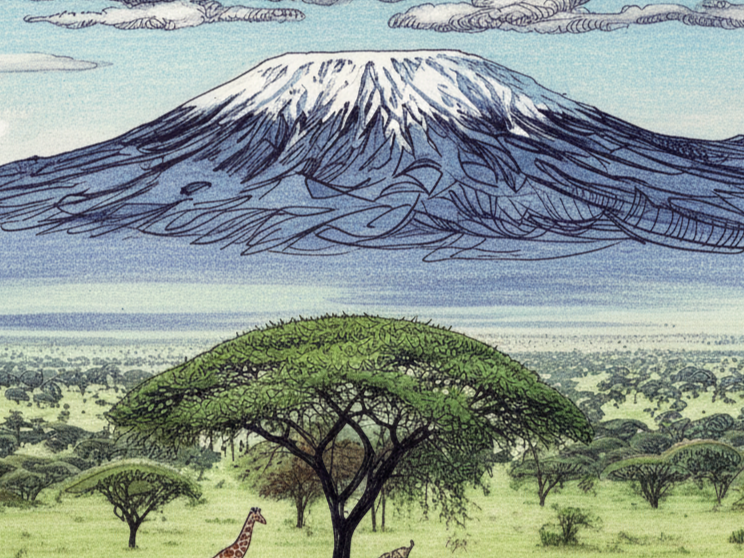
This time, we journey to Tanzania to explore the majestic Mount Kilimanjaro, a true wonder of the world, and discuss how its awe-inspiring beauty can be captured as digital art for your home.
Mount Kilimanjaro: Africa’s Iconic Summit and Its Allure
Mount Kilimanjaro, the highest peak in Africa, is not just a mountain; it’s a dormant volcano and a symbol of natural grandeur.
Standing at approximately 5,895 meters (19,341 feet) above sea level, its snow-capped summit against the African plains creates a breathtaking panorama.
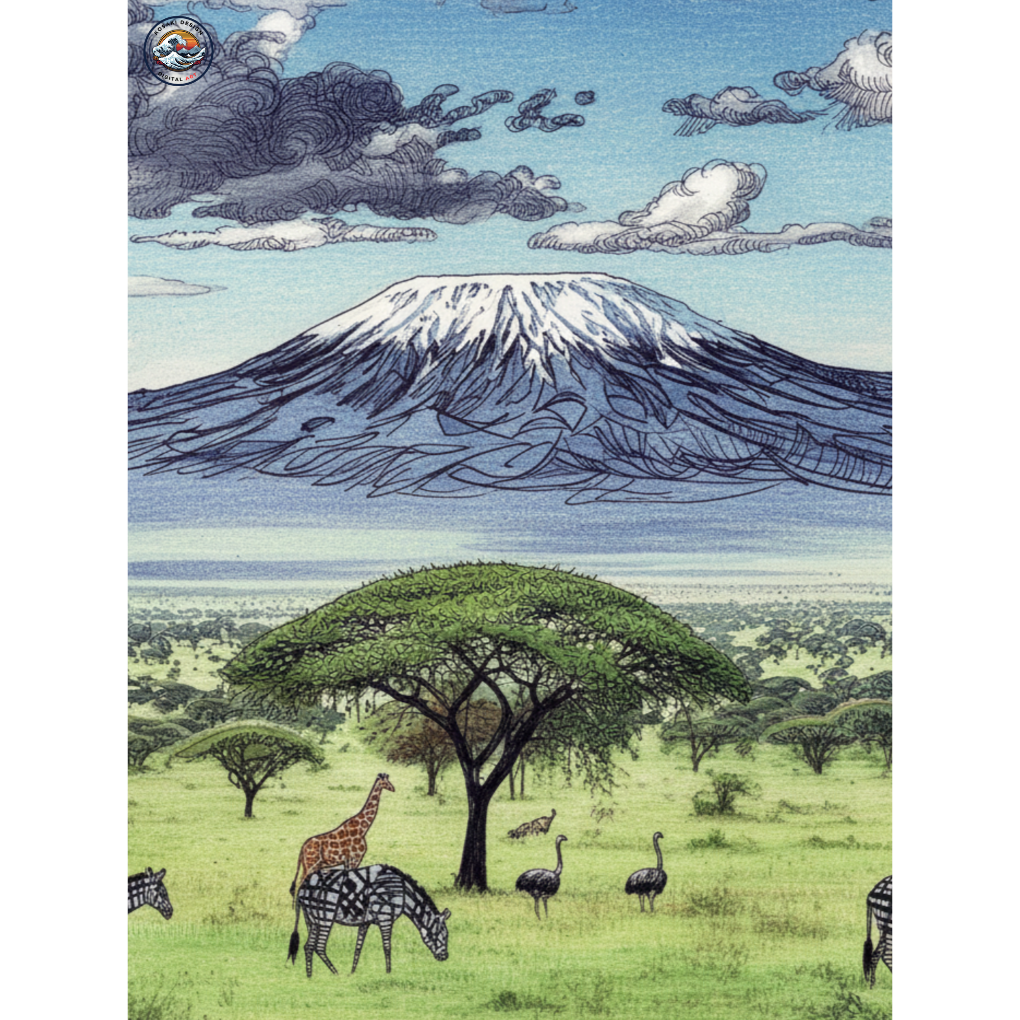
Kilimanjaro is unique for its diverse ecological zones, from cultivated land and rainforests at its base to alpine deserts and arctic conditions at its peak.
This incredible biodiversity, combined with the challenge of its ascent, draws adventurers and nature lovers from across the globe.
Kilimanjaro National Park
Kilimanjaro National Park encompasses the entire mountain above the tree line and is a UNESCO World Heritage site. It was established to protect the mountain’s unique environment, including its diverse flora and fauna, and to manage tourism sustainably. Park fees contribute to conservation efforts and local communities.
🏔️ The Roof of Africa
Kilimanjaro National Park is home to Mount Kilimanjaro, the highest mountain in Africa and the tallest free-standing mountain in the world at 5,895 meters (19,341 ft).
Located in Tanzania, this dormant volcano dominates the landscape, offering a majestic and iconic silhouette visible for miles around.
🌍 Five Distinct Climate Zones
A trek up the mountain is a unique ecological journey, often described as walking from the equator to the North Pole in a matter of days.
Hikers pass through five diverse zones: cultivated farmland, lush montane rainforest, heath and moorland, alpine desert, and finally, the arctic summit zone.
🐘 Rich Wildlife Sanctuary around Kilimanjaro
The lower slopes, particularly the dense rainforest belt, serve as a vital corridor for African wildlife.
Visitors may spot elephants, leopards, buffaloes, and rare primates like the blue monkey and black-and-white colobus monkeys, along with a vibrant array of bird species.
❄️ Snow on the Equator
Despite being located just three degrees south of the equator, the mountain’s summit, Uhuru Peak on the Kibo volcanic cone, is famous for its permanent ice fields and glaciers.
These shrinking snows create a stunning visual contrast against the surrounding African savannah and are a key subject of climate study.
🌿 UNESCO World Heritage Site
Designated a UNESCO World Heritage Site in 1987, the park protects not only the mountain but also the surrounding montane forest.
It is recognized for its superlative natural beauty and its significance as a major water tower for the surrounding agricultural regions of Tanzania and Kenya.
🥾 A Trekker’s Paradise
Kilimanjaro is one of the world’s most accessible high-altitude climbs, requiring no technical mountaineering skills for most routes.
It attracts thousands of adventurers annually who attempt to reach the “Roof of Africa” via famous trails like the Marangu, Machame, and Lemosho routes.
Key Features of the Kilimanjaro Mountain Trails
Here is a short description of the three most popular routes on Mount Kilimanjaro:
Marangu Route (“Coca-Cola”)
Known as the classic and oldest path, it is the only route offering hut accommodations instead of camping.
While often perceived as the easiest due to its gradual slope, its rapid ascent profile offers poor acclimatization, leading to a lower summit success rate.
Machame Route (“Whiskey”)
The most popular route, renowned for its stunning scenery and steeper, more challenging terrain.
It requires camping and follows a “climb high, sleep low” profile, which allows for better acclimatization and higher success rates than Marangu.
Lemosho Route
A longer, more remote western approach considered one of the most beautiful and complete experiences.
With low crowds at the start and an extended itinerary (7-8 days), it offers excellent acclimatization opportunities, resulting in one of the highest success rates on the mountain.
Shira Plateau
Located on the western side of Kilimanjaro, the Shira Plateau is one of the highest plateaus in the world and offers stunning panoramic views.
Kilimanjaro Giant Groundsel
The Kilimanjaro Giant Groundsel is the most iconic plant of Kilimanjaro’s afro-alpine zone, thriving nowhere else in the world.
This endemic species has thick, woody trunks topped by massive rosettes of hairy, cabbage-like leaves that close up at night to protect the core from freezing, an adaptation allowing it to survive the severe day-night temperature swings in the high-altitude moorlands.
🚠 Comparison of Kilimanjaro Trekking Routes
| Feature | Marangu Route | Machame Route | Lemosho Route |
| Level | Moderate (Gradual slope) | Strenuous (Steeper sections) | Strenuous (High endurance) |
| Duration | 5 – 6 Days | 6 – 7 Days | 7 – 8 Days |
| Starting Point | Marangu Gate (Southeast) | Machame Gate (Southwest) | Londorossi Gate (West) |
| Accommodation | Shared A-frame Huts | Wilderness Camping | Wilderness Camping |
| Summit Rate | Low (Rapid ascent) | High (Good acclimatization) | Highest (Best acclimatization) |
📝 Key Information for Trekkers
- Acclimatization is Key:
The Lemosho route is highly recommended for beginners or those worried about altitude sickness because the longer itinerary allows your body to adjust to the thinning air more naturally. - The “Barranco Wall”:
If you choose Machame or Lemosho, you will have to scramble up the Barranco Wall. It looks intimidating but does not require technical climbing gear—just your hands and feet. - Starting Points:
Most treks begin with a briefing in the towns of Moshi or Arusha. From there, you will be driven to the respective National Park gates to sign in and begin your hike. - Physical Preparation:
While non-technical, these treks require significant cardiovascular fitness. It is recommended to train by hiking on inclines with a weighted backpack for at least 2–3 months before your trip.
Would you like me to look up current permit costs or a recommended gear packing list for these routes?
Relax around Arusha, Mount Kilimanjaro
🌿 Culture and Cascade
The day begins with a refreshing hike through lush terrain to the stunning Materuni Waterfalls, nestled in the foothills of Mount Kilimanjaro.
This is followed by a captivating Chagga coffee tour, where visitors learn the traditional bean-to-cup process and grind their own beans.
💦 Oasis of Relaxation
The journey culminates at the Kikuletwa Hot Springs (Maji Moto), a secluded, palm-fringed oasis in the arid landscape.
Its crystal-clear, warm turquoise waters offer a perfect opportunity to swim, relax, and rejuvenate tired muscles.
🇹🇿 The Ultimate Day Trip
This popular combination tour provides a perfect single-day experience from the Moshi/Arusha area, seamlessly blending Tanzanian culture, natural beauty, and adventure.
It showcases the diverse environments near Kilimanjaro, from waterfalls and coffee groves to unique thermal springs.
Experience Kilimanjaro’s Majesty at Home with KOSAKI DESIGN Digital Art
The exhilaration of travel often fades with time.
However, with KOSAKI DESIGN’s digital art, the grandeur, resilience, and mystical allure of Mount Kilimanjaro can be a permanent fixture in your room.
Our digital artworks are far more than mere photographs.
They are meticulously crafted by professional artists who faithfully reproduce the subtle interplay of light and shadow, and the vibrant hues, creating immersive pieces that transport you directly to the mountain’s slopes.
Download your next digital art from here!!
Planning Your Kilimanjaro Expedition: Essential Information
Best Time to Climb Mount Kilimanjaro
The best times to climb Mount Kilimanjaro are during the dry seasons: January to mid-March and June to October.
These periods offer clearer skies, less rain, and more favorable climbing conditions.
While it is possible to climb outside these months, be prepared for more challenging weather, including heavier rainfall and colder temperatures.
Gateway City: Arusha, Tanzania
Arusha, Tanzania, serves as the primary gateway to Mount Kilimanjaro. It’s a bustling city with a vibrant market, offering a taste of local life before your ascent.
Most climbers arrive at Kilimanjaro International Airport (JRO), which is conveniently located between Arusha and Moshi, another key town for expeditions.
Getting There: From Nairobi, Kenya
Many international travelers fly into Jomo Kenyatta International Airport (NBO) in Nairobi, Kenya, due to a wider range of flight options.
From Nairobi, you can take a regional flight to JRO or a shuttle bus directly to Arusha.
Shuttle services are reliable and offer a scenic journey across the border.
Recommended Accommodation
In Arusha:
- Mount Meru Hotel: A luxurious option with stunning views of Mount Meru.
- URL: https://www.mountmeruhotel.co.tz/
- TEL: +255 27 254 8600
- Approx. Cost: From $200 per night
In Nairobi:
- Sarova Stanley: A historic hotel in the heart of the city, offering colonial charm and modern amenities.
- URL: https://www.sarovahotels.com/stanley-nairobi/
- TEL: +254 719 022000
- Approx. Cost: From $180 per night
Mountain Madness Tour Information
For a guided and well-supported climbing experience, consider Mountain Madness.
They are renowned for their expertise in high-altitude expeditions and offer various Kilimanjaro routes with experienced guides and comprehensive logistics.
- URL: https://mountainmadness.com/trips/kilimanjaro-guided-climb-and-safari#overview
- Approx. Cost: Varies significantly based on route, duration, and group size
Useful Links
- Tanzania National Parks (TANAPA): https://www.tanzaniaparks.go.tz/
- Tanzania Tourist Board: https://www.tanzaniatourism.go.tz/
- Nairobi City County: https://nairobi.go.ke/