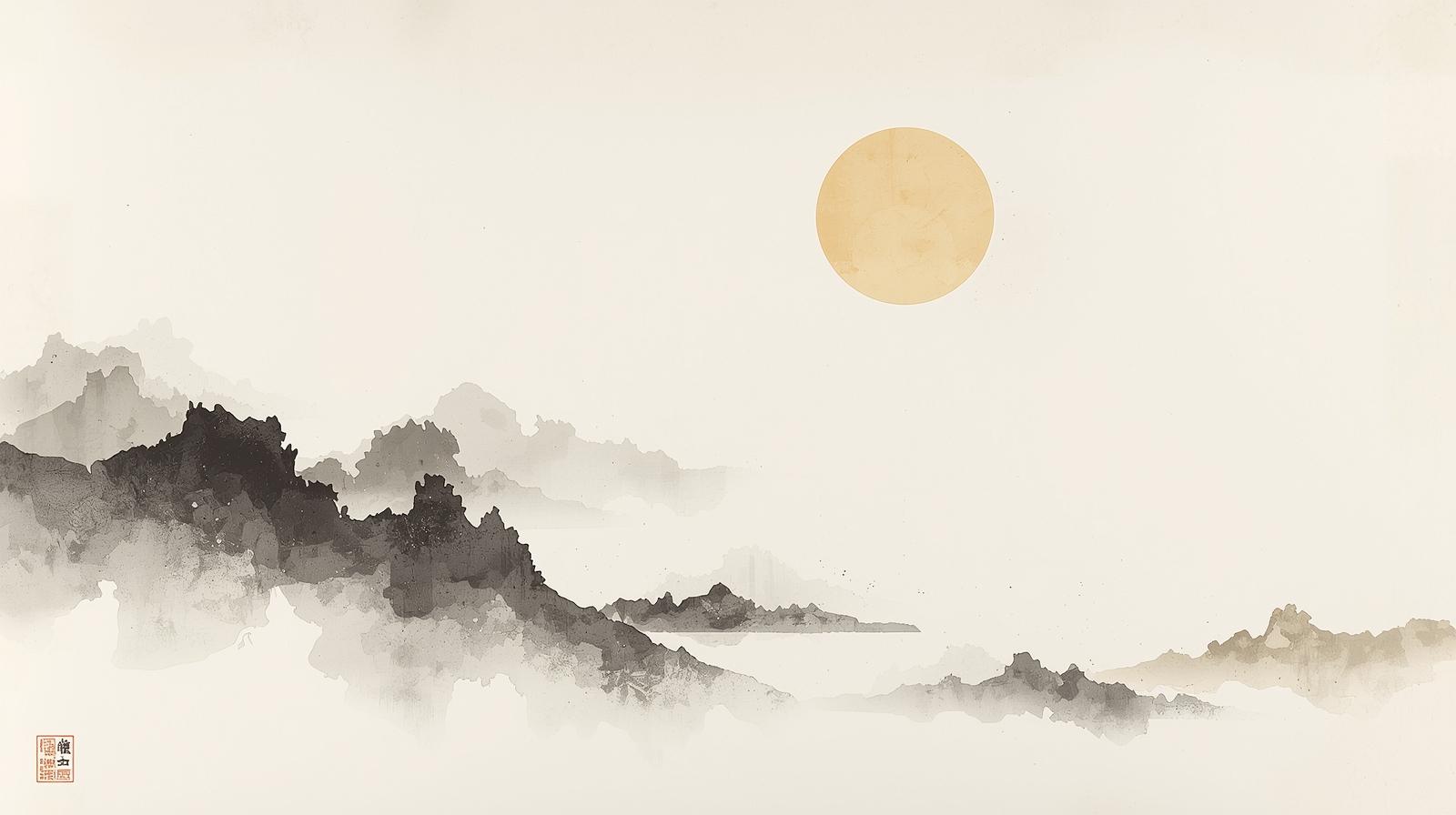
Minimalism is often misunderstood as mere emptiness.
In Japanese aesthetics, this is known as Ma (間)—the purposeful void, the active space that defines and gives profound meaning to the objects within it.
In the competitive digital landscape, generating this delicate balance via AI requires more than just artistic flair; it demands a deep understanding of Prompt Engineering.
At KOSAKI DESIGN ART, we treat Midjourney not merely as a creative tool, but as a high-precision rendering engine.
This article provides five meticulously engineered prompts to bridge the gap between silicon logic and the Japanese art principles.
For creators aiming to elevate their AI art beyond generic outputs, and for collectors seeking genuine “Logic-Driven Art,” mastering the philosophy and technical application of Japanese minimalism in AI is paramount.
Our goal is to demonstrate how careful parameter tuning can achieve the timeless tranquility of traditional Japanese art, perfectly aligned with our vision for the World Digital Atelier.
- 1. The Philosophy of “Ma” in Digital Latent Space
- 2. Five Master Prompts: Engineering Visual Serenity
- 3. Spotlight: “Kilimanjaro Coffee” — Fusing Heritage with Global Energy
- 4. Technical Mastery: Tuning Midjourney Parameters for Professional Results
- 5. Why Collectors Seek “Japanese Minimalism”
- 6. Conclusion: The Future of Art is Bionic and Intentional
1. The Philosophy of “Ma” in Digital Latent Space
Before we even begin prompting, we must understand how an AI model perceives “nothingness.”
Unlike a human artist who intuitively understands negative space, an AI model’s default behavior is often to “fill” the canvas.
Generating effective minimalism, therefore, requires active suppression and precise instruction within the prompt.
Negative Space vs. Active Space: The Art of Subtraction
The concept of “Ma” teaches us that the empty spaces are as important as the forms.
In Midjourney, this translates to mastering the `–no` parameter.
For instance, `–no clutter, unnecessary details, complex patterns` doesn’t just remove elements; it tells the AI to create intentional voids.
This act of digital subtraction is an IT engineering skill, reducing the “noise” in the latent space to reveal the core essence.
The Complexity of Simplicity: Preventing Over-Filling
It’s counter-intuitive, but a minimalist prompt often needs more technical constraints to prevent the AI from “over-filling” the canvas.
Without specific instructions for extreme minimalism or the deliberate use of negative space, the AI might interpret a simple prompt as an invitation to add intricate textures or background elements.
This requires a precise “logic gate” in our prompting strategy.
2. Five Master Prompts: Engineering Visual Serenity
Each of these prompts is designed with specific “Engineering Hooks”—keywords and parameters that precisely control lighting, texture, and compositional logic, helping Midjourney understand the subtle nuances of Japanese minimalism.
A. The Sumi-e Flow (Monochrome Elegance)
Prompt: A single, fluid brushstroke of black ink representing a distant mountain, soft charcoal texture, vast white washi paper background, Japanese Sumi-e style, extreme minimalism, high-contrast, atmospheric perspective, 8k resolution, –ar 16:9 –v 6.0 –stylize 200 –iw 0.75
Engineering Logic: We emphasize “vast white washi paper background” and “high-contrast” to force the AI to respect the negative space. The `–stylize 200` ensures artistic interpretation without excessive detail, while `–iw 0.75` gives priority to the text prompt’s composition over Midjourney’s default aesthetic.
B. Geometric Style (Modern Architecture)
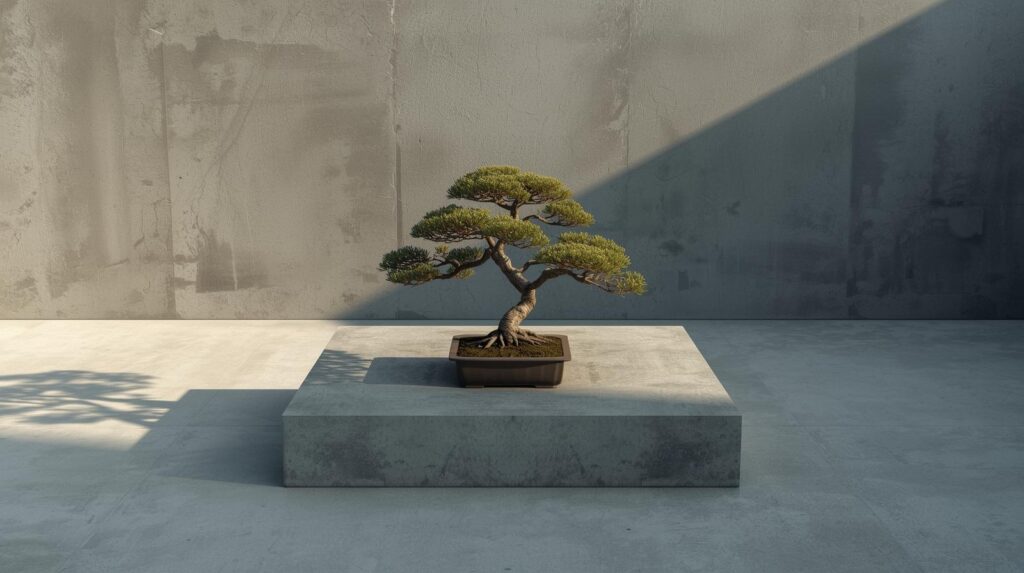
Prompt: Isometric view of a single bonsai tree on a monolithic concrete slab, soft morning shadows, clean lines, Japanese brutalist minimalism, muted earth tones, cinematic lighting, sharp focus, –ar 4:5 –v 6.0 –no foliage, complex patterns
Engineering Logic: “Isometric view” and “brutalist minimalism” enforce mathematical rigidity and stark simplicity. “Monolithic concrete slab” creates a clear, unadorned base, and `–no foliage, complex patterns` actively prevents the AI from adding distracting elements.
C. The Floating World (Contemporary Ukiyo-e)
Prompt: Flat vector illustration of a single koi fish, swimming through abstract waves, indigo blue palette, subtle woodblock print texture, gold leaf accents, minimal composition, clean edges, Ukiyo-e logic, –ar 2:3 –v 6.0 –s 150 –q 2 –no shadows, excessive detail
Engineering Logic: “Flat vector illustration” and “clean edges” guide the AI toward a graphic, simplified style. “Ukiyo-e logic” cues the AI for traditional compositional principles, and the `–s 150` (stylize) keeps it less abstract, more focused on the core subject.
D. Abstract Textures (The Wabi-Sabi Macro)
Prompt: Extreme macro photography of cracked ceramic with kintsugi gold repair, a single imperfection, beige stone background, soft focus, tactile texture, silent composition, –v 6.0 –chaos 10 –no sharp edges, intricate patterns, vibrant colors
Engineering Logic: “Extreme macro photography” ensures a tight, focused view. “Kintsugi gold repair” introduces controlled detail, while `–chaos 10` adds a touch of organic randomness to the crack patterns without losing overall control. The negative prompt `–no vibrant colors` enforces the muted Wabi-Sabi palette.
E. The Seasonal Void (Atmospheric Minimalism)
Prompt: A single red maple leaf on a frozen pond, vast negative space, misty atmosphere, haiku-inspired visual, desaturated colors, ethereal lighting, –ar 1:1 –v 6.0 –quality 2 –no distracting elements, harsh lines
Engineering Logic: “Vast negative space” is a direct command for minimalism. “Misty atmosphere” and “ethereal lighting” create depth and softness. `–quality 2` ensures finer details in the leaf without increasing overall complexity, and `–no harsh lines` maintains the gentle aesthetic.

3. Spotlight: “Kilimanjaro Coffee” — Fusing Heritage with Global Energy

The Concept: Global Trends Meets Traditional Logic
At KOSAKI DESIGN ART, we believe minimalism can be a universal language.
“Kilimanjaro Coffee” takes the raw, vibrant energy of African coffee culture and filters it through the serene, structured lens of Japanese minimalist design.
It’s a dialogue between continents, presented through the elegance of reduction.
The iconic mountain shape, the single coffee bean, and the stylized steam are all carefully placed elements with Japanese minimalism.
4. Technical Mastery: Tuning Midjourney Parameters for Professional Results
To achieve “Atelier Quality” in minimalist AI art, you must master Midjourney’s “Global Variables”—its various parameters. These are your digital chisels.
–Stylize: Controlling Artistic Interpretation
The `–stylize` parameter (s) dictates how strongly Midjourney’s default aesthetic influences the output.
For minimalism, a lower stylize value (e.g., `–s 50` to `–s 200`) often leads to cleaner, more direct interpretations of your prompt, preventing the AI from adding excessive artistic flourishes that detract from simplicity.
–No: The Power of Negative Prompts
This is arguably the most critical parameter for minimalism.
Using phrases like `–no extra detail, intricate patterns, ornate elements, busy background` actively tells the AI what *not* to generate, thereby creating the intentional voids and clean spaces that define “Ma.” This is precise “subtraction engineering.”
Aspect Ratios: Engineering Space
The `–ar` (aspect ratio) parameter significantly impacts the sense of space.
A wide aspect ratio like `–ar 21:9` can create a “Cinematic Horizon,” enhancing the feeling of emptiness and grandeur. Conversely, a square `–ar 1:1` can force focus on a single, centralized element.
5. Why Collectors Seek “Japanese Minimalism”
In a world of constant digital noise and visual clutter, silence is a luxury. “Logic-Driven Art” that embraces Japanese minimalism offers profound benefits to collectors.
The Psychology of Calm and Investment Value
Minimalist art is proven to reduce cognitive load and evoke feelings of calm and serenity, making it ideal for high-stress environments like home offices or meditation spaces.
Furthermore, “Engineered Minimalism”—art that clearly demonstrates intentionality and technical skill beyond simple prompting—holds significant investment value.
Collectors recognize the difference between a random AI generation and a meticulously crafted, “Bionic” masterpiece.
6. Conclusion: The Future of Art is Bionic and Intentional
Japanese minimalism is not about doing less; it is about achieving more with less.
By applying the IT engineering principles of precision, subtraction, and logical hierarchy to AI prompting, we can create art that transcends the machine’s initial output.
At KOSAKI DESIGN ART, our commitment is to produce pieces that are both technologically advanced and deeply resonant with human emotion.
We invite you to explore the quiet power and profound meaning within our collection.
Discover how the “Logic of Ma” can transform your space and bring a sense of refined tranquility to your digital and physical life.
Explore Our Minimalist Collection
Visit the KOSAKI DESIGN ART SHOP today. Find your piece of digital art, where every brushstroke, every void, and every pixel is a testament to the Bionic Renaissance.