The digital art landscape of 2026 is a far cry from the experimental turbulence seen in the early 2020s.
We have moved past the era of “prompt-and-pray,” where users simply typed a few words and hoped for a usable result.
Today, the revolution is defined by a sophisticated symbiosis between human intuition and machine intelligence.
At KOSAKI DESIGN, we have tracked this evolution from the first generative models to the current state of “Neural Atelier” environments.
This transformation is not merely about speed; it is about the expansion of human capability.
In this post-generative era, the novelty of AI has faded, replaced by a deep requirement for intentionality.
As the internet became flooded with synthetic content, the market’s “immune system” reacted by placing a premium on works that demonstrate a clear human lineage.
In 2026, we don’t just ask what the AI did; we ask what the artist intended.
This article serves as a comprehensive guide to the technologies, philosophies, and economic shifts that have redefined what it means to be a creator in the mid-2020s.
- The Technological Leap: From Generic Models to Personalized Intelligence
- The Death of the “AI Aesthetic” and the Renaissance of Human Imperfection
- Case Study: Ukiyo-e 2.0 – Merging 18th Century Tradition with 2026 Technology
- Spatial Computing and the Rise of Tactile Art Experiences
- The Economics of Art in 2026: Provenance, Transparency, and Value
- Conclusion: The Final Frontier of Imagination
The Technological Leap: From Generic Models to Personalized Intelligence
The most significant technical shift in 2026 is the move toward Hyper-Localized Models.
In 2024, artists were forced to use “Global Models” trained on billions of images that didn’t belong to them.
This led to a generic “AI look” that lacked soul.
By 2026, professional ateliers have transitioned to private, high-fidelity neural manifolds.
These models are trained exclusively on an artist’s own historical works, sketchbooks, and curated datasets, ensuring that the AI understands the “artist’s intent” before a single pixel is generated.
The Rise of Localized Fine-Tuning (LFT)
Localized Fine-Tuning, or LFT, allows a creator to “bake” their personal style into an AI assistant.
Instead of a general understanding of “watercolors,” an LFT model at KOSAKI DESIGN understands our specific way of blending indigo pigments and our unique brush pressure.
This has turned the AI from a replacement artist into a “bionic brush.”
It understands the mathematics of the creator’s aesthetic, allowing for a level of stylistic consistency that was previously impossible across large-scale projects.
Advancements in Neural Manifold Manipulation
In 2026, we no longer interact with AI through simple text boxes alone.
We use “Latent Space Mapping,” where artists can physically manipulate the mathematical dimensions of an image.
By adjusting variables like “textural friction” or “chromatic depth,” we can guide the AI with surgical precision.
This technology has eliminated the “hallucination” problem of early AI, giving artists 100% control over the final output while still benefiting from the generative power of the machine.
The Death of the “AI Aesthetic” and the Renaissance of Human Imperfection
By the end of 2025, the digital world hit a wall of “Perfection Fatigue.”
AI-generated images were too smooth, too symmetrical, and too hollow.
The human eye, evolved over millions of years to detect subtle natural variations, began to instinctively reject “perfect” pixels.
This led to the most surprising trend of 2026: the intentional introduction of Digital Friction.
The Premium on “Digital Friction”
Digital Friction is the practice of adding purposeful errors, hand-drawn artifacts, and organic noise to digital art.
At the World Digital Atelier, we use AI to simulate the way real ink bleeds into paper fibers or how a physical woodblock wears down over time.
These “imperfections” are what signify human presence to the viewer.
In 2026, the value of an artwork is often measured by how much “struggle” is visible in the final piece.
We have moved from a culture that celebrates the “effortless” to one that craves the “effortful.”
The Psychology of the Modern Collector
Collectors in 2026 are highly educated. They can spot a “raw generation” instantly.
As a result, the market has bifurcated. On one side, there is mass-market synthetic content that is free or nearly free.
On the other, there is “Atelier Art”—work that is human-conceived, AI-assisted, and hand-refined.
The latter is where KOSAKI DESIGN operates, catering to those who understand that true art is a dialogue, not a monologue by an algorithm.
Case Study: Ukiyo-e 2.0 – Merging 18th Century Tradition with 2026 Technology
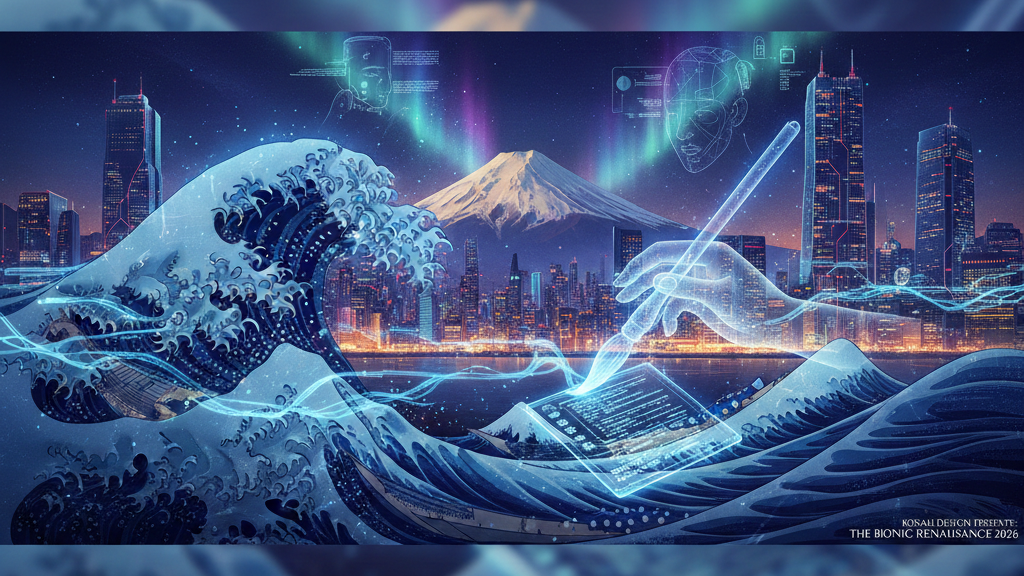
Our work on the Ukiyo-e 2.0 series, particularly the piece KDA000002 – Taroko Ocean, represents the pinnacle of our 2026 philosophy.
Ukiyo-e, the “pictures of the floating world,” was originally a collaborative process between an artist, a carver, and a printer.
In our modern version, the AI takes the role of the carver and the printer, while the human remains the absolute director.
Simulating the Physics of the Woodblock
To create Taroko Ocean, we didn’t just ask the AI for a “Taroko Gorge.”
The AI calculated the exact way a mineral pigment like Prussian Blue would sit on the surface of Kozo paper.
It simulated the “Baren” (the tool used to rub the paper against the block) pressure, creating a subtle grain that changes depending on the light.
This is not a “filter”; it is a digital simulation of a physical process.
Technical Specifications of Taroko Ocean
This piece was rendered at a high-quality resolution, allowing for detail that is invisible to the naked eye but felt in the “weight” of the image.
By using a custom-built AI bridge between traditional drafting and neural rendering, we achieved a harmony between the futuristic “Neo-Tokyo” subject matter and the centuries-old aesthetic of the Edo period.
This is “Art Engineering” in its purest form.
Spatial Computing and the Rise of Tactile Art Experiences
In 2026, digital art has finally left the two-dimensional screen.
The widespread adoption of Spatial Computing devices has transformed how we interact with the KOSAKI DESIGN ART SHOP.
When a client views a piece like KDA000002 (Taroko Ocean) in their AR glasses, the art recognizes the physical room it is in.
It casts shadows on the user’s real walls and reflects the actual light coming through their windows.
Haptic AI and the Sense of Touch
Through advanced haptic feedback systems, 2026 has introduced “Tactile Art.”
While the artwork remains digital, AI-driven haptic devices allow the collector to “feel” the grain of the woodblock or the thickness of the paint.
This sensory expansion has changed the valuation of digital art; it is no longer just a visual asset, but a multi-sensory experience.
The digital art of 2026 is an object you can live with, not just look at.
The Economics of Art in 2026: Provenance, Transparency, and Value
With the ability for AI to generate infinite content, how does one maintain value?
The answer in 2026 is Provenance. We utilize “Creative Ledger” technology, where every step of the artistic process is recorded on a blockchain.
A collector can audit the entire lifecycle of a piece: from the first human-drawn line to the specific AI seeds used, to the final three days of hand-painting the digital highlights.
The New Definition of Scarcity
In 2026, scarcity is no longer about the file itself, but the “Human Hours” invested.
At KOSAKI DESIGN, we document the labor behind each piece.
When a client buys from our shop, they are buying a certificate of human labor.
This transparency has built a new level of trust in the art market, allowing us to reach our goal of sales per month by focusing on quality over quantity.
Conclusion: The Final Frontier of Imagination
The revolution of 2026 has taught us that technology does not replace creativity; it demands more of it.
As AI takes over the “how” of art creation, artists are forced to focus more deeply on the “why.”
The digital art scene is no longer a race to the bottom of automation, but a climb to the peak of human expression.
At KOSAKI DESIGN, we remain committed to this bionic future, where every pixel is powered by technology but guided by the human soul.
We invite you to explore this new world with us, one masterpiece at a time.
Secure Your Piece of the Future
The 2026 collection is now available at the KOSAKI DESIGN ART SHOP.
Each piece is a testament to the harmony of heritage and innovation.
Join us in defining the next era of digital aesthetics.