The traditional boundaries of the creative industry are dissolving.
In the early days of digital art, a graphic designer was someone who understood color, typography, and composition, while an IT engineer was someone who understood code, architecture, and logic.
However, as we navigate the landscape, these two worlds have merged into a single, high-impact discipline.
At KOSAKI DESIGN ART, we define this as the “Bionic Renaissance”—a period where engineering skills are not just a bonus, but the very brush and chisel of the modern creator.
To understand why IT skills are the ultimate multiplier for graphic design, we must look beyond the surface of the image and into the systems that create them.
The modern designer is no longer just a “decorator” of screens; they are the architects of experiences.
In a world saturated with generic, AI-generated visuals, the ability to engineer unique workflows and manipulate the underlying logic of design tools is what separates a professional atelier from a hobbyist.
This article explores the profound ways IT engineering skills transform the creative process, enhancing everything from workflow efficiency to the very soul of the artwork.
- 1. Algorithmic Thinking: Designing with Logic and Structure
- 2. Automation and Workflow Engineering: The Power of Scripting
- 3. Mastering the Medium: Rendering, Shaders, and Performance
- 4. AI Engineering: Beyond the Prompt
- 5. The Global Competitive Advantage: IT x Art x Heritage
- 6. Conclusion: The Emergence of the Creative Architect
1. Algorithmic Thinking: Designing with Logic and Structure
At its core, IT engineering is about problem-solving through logic.
This “Algorithmic Thinking” is perhaps the most significant gift an IT background gives to a designer.
While a traditional artist might place an element “where it looks right,” a logic-driven designer places it according to a structural hierarchy that accounts for scalability, responsiveness, and user psychology.
This systematic approach ensures that the design is not just a static image, but a robust system that functions across multiple platforms.
From Visual Chaos to Data-Driven Hierarchy
Design is data.
Whether it is a website, a social media campaign, or a piece of digital Ukiyo-e, the visual elements are governed by relationships.
Designers with engineering skills treat these elements as objects within a system.
By applying data structures to visual information, they can create designs that are inherently balanced.
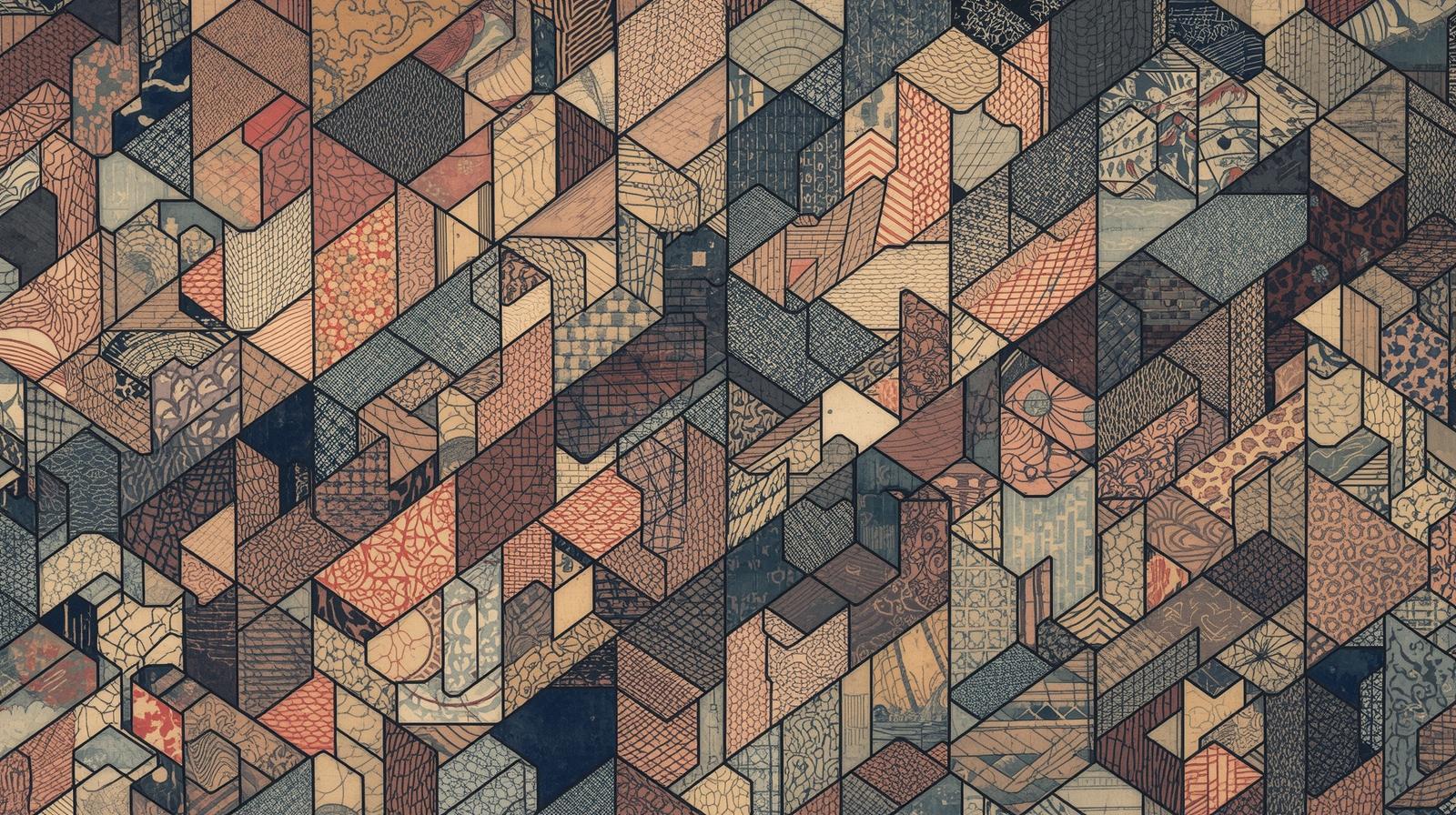
This is particularly relevant in the “Fusion of AI and Abstract Art,” where the complexity of the patterns requires a logical framework to maintain harmony.
The Mathematics of Aesthetic Balance
Many of the world’s most enduring aesthetic principles, such as the Golden Ratio or the silver ratio often used in Japanese architecture, are deeply mathematical.
An IT engineer is comfortable with these numerical relationships.
They can use code to generate “Perfect Composition” grids that adapt dynamically to any aspect ratio.
This precision allows KOSAKI DESIGN to create digital art that feels “right” to the human eye, even when the subject matter is highly abstract or futuristic.
2. Automation and Workflow Engineering: The Power of Scripting
One of the greatest bottlenecks in graphic design is repetitive labor.
Task-heavy actions—such as resizing a hundred images, renaming layers, or harmonizing color palettes across a massive project—can drain a creator’s energy.
Here, IT skills like Python scripting or ActionScript proficiency become a superpower.
A designer who can code is a designer who can automate the mundane, freeing up their mind for true high-level creativity.
Building Custom Tools and Generative Systems
The professional designer does not just use tools; they build them.
Using IT skills, we can create custom scripts within software like Adobe Creative Cloud or Figma that handle complex “Batch Processing.”
More importantly, we can build Generative Systems.
Instead of designing a single logo, we engineer a “Brand Algorithm” that can generate thousands of unique, on-brand variations based on set parameters.
This is how KOSAKI DESIGN manages a growing inventory of over 100 digital art pieces while maintaining a standard of absolute quality.
Case Study: Inventory Management via Metadata
Managing a collection of 100+ digital art pieces requires more than just a folder on a hard drive.
It requires an engineered metadata system.
By using IT skills to automate the tagging and categorization of our “Fusion Ukiyo-e” series, we ensure that every piece is globally searchable and properly archived.
This technical backbone is what allows us to focus on our primary goal: delivering 10 high-quality masterpieces to collectors every month without administrative burnout.
3. Mastering the Medium: Rendering, Shaders, and Performance
Every medium has its limitations and strengths.
A painter must understand the chemistry of oil and canvas; a digital designer must understand the physics of pixels and light.
IT engineering provides a deep understanding of how images are rendered by a Graphics Processing Unit (GPU) or displayed in a web browser.
This knowledge is critical for optimizing high-fidelity art for the global market.
The Art of High-Fidelity, Low-Weight Art
In the digital world, “Weight” is a design constraint.
A beautiful 4K illustration is useless if it takes ten seconds to load on a mobile device or a VR headset.
Engineers understand file compression, SVG path optimization, and memory management.
By applying IT logic, we can create “Bionic Designs” that look stunningly detailed but are mathematically optimized for instant loading.
This technical polish is a hallmark of the KOSAKI DESIGN ART SHOP, ensuring a seamless experience for our global collectors.
Interactive Art and Living Code
Graphic design is moving away from static images toward “Living Art”—pieces that react to user input, movement, or environmental data.
This requires a mastery of JavaScript, specialized shaders, and real-time rendering engines.
When a designer understands code, they can create art that breathes.
For example, a digital Ukiyo-e piece could subtly shift its lighting based on the time of day in the collector’s location.
This level of immersion is only possible through the fusion of IT skills and graphic design.
4. AI Engineering: Beyond the Prompt
The world is flooded with “Prompt Engineers,” but there is a massive gap between someone who can write a text prompt and someone who can engineer an AI framework.
IT skills allow a designer to go “under the hood” of generative AI. This includes Fine-Tuning Models and Latent Space Manipulation.
Training the “Bionic Brush”
At KOSAKI DESIGN, We feed our systems centuries of Ukiyo-e data alongside our own abstract photography. This isn’t just “using AI”; it is “teaching AI” our unique visual language.
An artist without IT skills is limited to the “average” style of a public model.
An artist with IT skills creates a private, proprietary engine of imagination.
Pixel-Level Control through Code
Non-technical designers often struggle with the “unpredictability” of AI.
A designer with an IT background understands the mathematics of “Diffusion” and “Noise.”
They can use specialized code to “guide” the AI at a pixel level, ensuring that the final output is 100% aligned with their human intent.
This is the difference between an accidental image and an engineered masterpiece.
5. The Global Competitive Advantage: IT x Art x Heritage
The global market for digital art is incredibly competitive.
To stand out, a creator must offer something that cannot be easily replicated by an algorithm or a low-cost service.
The combination of IT Engineering Skills and Japanese Aesthetics creates a “Blue Ocean” strategy—a market space where KOSAKI DESIGN ART stands alone.
Global Standards and Ethical Data
IT skills also encompass an understanding of data ethics and security.
Collectors are increasingly concerned with how art is made.
By engineering our own “Clean Data” pipelines and using blockchain for provenance, we provide a level of transparency that build trust with high-net-worth individuals.
This technical “Logic of Trust” is a key driver in reaching our goal of 10 sales per month.
Bridging Tradition and the Future
We view traditional Japanese Ukiyo-e as a “System” of its own.
It was a process of layers, specialized tools, and collaborative logic.
By applying modern IT engineering to this ancient system, we aren’t just making “New Ukiyo-e”; we are continuing the evolution of the craft.
The engineering mindset allows us to preserve the “Wabi-Sabi” (the beauty of imperfection) while utilizing the “Bionic” power of technology.
6. Conclusion: The Emergence of the Creative Architect
The question is no longer “should a designer learn to code?” but “can a designer survive without it?”
IT engineering skills do not stifle creativity; they liberate it.
They provide the structure that allows imagination to scale.
They provide the automation that allows the human soul to focus on what matters.
And they provide the technical depth to create art that is truly immersive, responsive, and unique.
At KOSAKI DESIGN ART, we are proud to be Creative Architects.
Our 100+ digital art pieces are not just “drawings”; they are engineered experiences.
As we look toward the future, we invite you to explore a world where the logic of the machine and the spirit of the artist are one and the same.
Join the Bionic Renaissance
Explore our logic-driven “Fusion of AI, Abstract, and Ukiyo-e” collection at the KOSAKI DESIGN ART SHOP.
Experience art that has been engineered for the future, today.
Would you like me to help you create a specific “Skill-Up Roadmap” for your team to integrate these IT skills into your design workflow, or should we focus on a Technical Breakdown of one of your specific 100+ art pieces?